Seven Years Later, Finally Back to China
Since moving my family to New Zealand, my last trip back to China was in 2018, before COVID. It’s been so long partly because my 2018 trip was so convenient — flights were incredibly cheap, it felt like taking a sleeper train to another city in China, 12 hours and you’re home. The other reason was COVID. China’s strict pandemic policies were confusing — I could never figure out the whole “three tests in two days” thing, plus mandatory quarantine on arrival. It kept me away. Now the pandemic controls are gone, flights are cheap again, so I decided to go back.
Qian often talks about “reverse culture shock” — spending so long abroad that returning home feels disorienting. I wouldn’t go that far, but I definitely felt that after so many years away, even a single trip back was quite an experience. Many things amazed me.
Itinerary
I had plenty of leave saved up, so I took Qian back first. His mom had to wait two more weeks before she could join us. Our route was roughly:
Auckland → Pudong Airport → Linyi (my hometown) → (mom joins) Suzhou (her hometown) → Linyi → Beijing → Suzhou → Pudong → Auckland Everything except the ride from Suzhou to Pudong was by high-speed rail. The biggest takeaway: high-speed rail is incredibly convenient and cheap. I vividly remember my university days in Shanghai — it took 12 hours by train to get to Lianyungang in Jiangsu, and then my dad would drive to pick me up. Now it’s 4 hours from Shanghai to home, including transfers. If this existed back then, I could’ve gone home every weekend. Although, my grades probably would’ve suffered.
When I told my colleagues about China’s high-speed trains — Americans, Europeans, and Kiwis alike — everyone was envious. New Zealand will probably never get high-speed rail. The country’s too small — you’d barely get going before you had to stop. Besides, New Zealand’s scenery deserves a slow pace. They have what’s called the world’s most beautiful railway — if it were high-speed, you’d miss all the views.
Impressions
Air Quality
My first impression stepping off the plane: the air was amazing, especially the clear blue sky. In my decade-plus in Shanghai, I’d never seen such blue skies. Back then, smog was the norm. When Qian was little, he coughed constantly. We’d take him to the hospital, which would be full of kids his age, all coughing, and the doctors had no real solutions. You can’t cure smog.
After landing, I took the maglev — not many countries have those. On the subway, I made a point of stopping at Lujiazui with Qian. As a kid born in Shanghai (ID number starting with 310), he barely remembered Lujiazui, which was a shame. The weather was great, and the place felt open and inclusive. Christmas decorations were everywhere. I’d heard people abroad say China was cracking down on foreign holidays, but seeing Lujiazui decked out for Christmas, that claim seemed absurd.
We visited Linyi (my hometown), Beijing, and Suzhou. Great weather, clean air everywhere. My throat was a bit sore the first few days, but that might’ve been from the heated indoors, not the air. Pictures (clockwise from top-left: Linyi, Suzhou, Shanghai, Beijing):
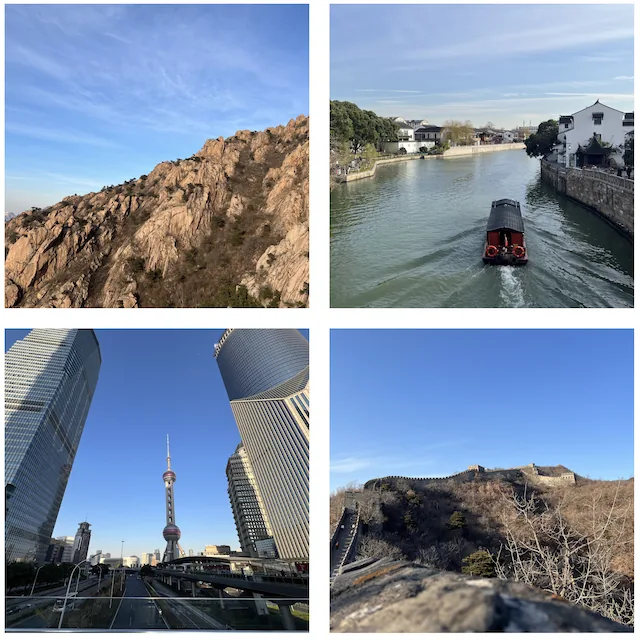
Back in New Zealand, whenever colleagues asked how my trip was, I just said: “The air was great, the sky was so blue.” They asked why, and I honestly don’t know the exact reasons. My guesses:
- More EVs, less pollution from gasoline
- Trade wars shipping polluting industries to Vietnam and India
- More solar and wind power, less coal
- Government policies phasing out heavy polluters
Of course, I was only there for a month — small sample size. Maybe if I stayed longer, I’d feel differently. But in all my years in New Zealand, I’ve never heard anyone say China’s air has improved this much. Shows how disconnected I’ve become. You can follow the news all you want, but you never really know how much a place has changed until you experience it yourself.
Technology & Society
The pace of technological change was stunning. I often joke that my understanding of Chinese tech is stuck in 2011 — I went to Hong Kong for my PhD that year, and moved to New Zealand shortly after graduating. So I had no real concept of what had developed. This trip, I learned a ton of new vocabulary: “you scan me or I scan you” (QR code payments), face-scan payments, shared bikes, ad-subsidized phone charging, ride-hailing apps. New Zealand has some of this — Uber, Lime scooters — but I’d never tried them at home. This time I tried everything, and I finally understand why Chinese people are so addicted to their phones. Everything requires your phone: ride-hailing, bike-sharing, even subway entry with QR codes. Many of these apps don’t have web versions, or the web versions are severely limited (like Taobao, where returns and after-sales service are mobile-only). So you’re forced to use the app. Probably so they can collect data they can’t get from a browser — your location, your phone model (proxy for income), etc.
AI applications were everywhere. Alipay’s face-scan payment was my first encounter. Then I saw an AI-powered weighing scale at the grocery store that identifies vegetables. Its accuracy could use improvement, but being able to pick from a short list of suggestions beats scrolling through hundreds of items. I imagine the tuning philosophy is: false positives are okay, but false negatives are absolutely not — if it can’t identify something, it’s worse than having no AI at all.
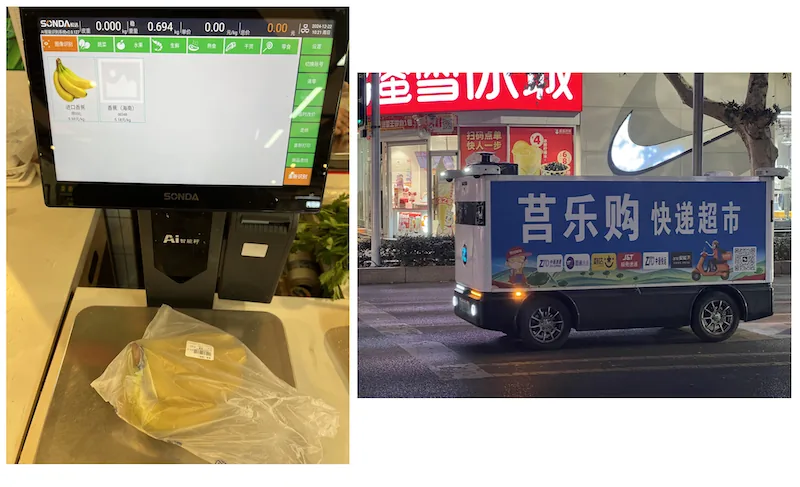
Then there were autonomous delivery vehicles. Truly driverless — no steering wheel, no cabin. They don’t deliver door-to-door; they deliver to a nearby convenience store (I later learned these are called “Cainiao Stations,” though “station” seems like a stretch — ancient Chinese stations served a different purpose). Then you get a message to pick up your package. NZ Post partners with local pharmacies for the same purpose, but they only receive parcels, don’t deliver to them. Since China’s logistics costs are incredibly low (at the expense of delivery workers), many convenience stores have essentially abandoned their main business to focus entirely on package handling.
Many of my old classmates now drive EVs, but I haven’t seen autonomous private cars yet. Too dangerous — unlike delivery vehicles where accidents are low-risk.
Honestly, I don’t think China needs autonomous delivery vehicles or robotaxis. Labor is cheap, and these jobs are lifelines for unemployed workers. If all delivery riders are replaced by drones and autonomous vehicles, the resulting unemployment would be a massive social problem. The technology should develop, sure, but actual deployment? Send it to places like New Zealand — vast, sparsely populated, with expensive labor.
Solar power was another big theme. Western media constantly talks about China’s solar overcapacity — so much that New Zealand farmers find it cheaper to import Chinese solar panels for fences than to build regular fences. They don’t even connect them to the grid — they just stand there as fences. This trip, I saw solar panels everywhere. My parents’ new apartment building came with solar as standard — one small system per unit. I heard many farmers have solar installations, but the main grid is at capacity, so they can only feed in during peak hours. Some farmers feel ripped off. Others are scrapping old EVs just to harvest their batteries — charge from solar during the day, discharge during peak hours. One friend works near a hydroelectric dam — they generate during peak demand, then pump water back uphill at night, turning the reservoir into a giant battery. My German colleagues told me they do something similar with massive concrete blocks — lift them at night when electricity is cheap, drop them during peak hours to generate power. Same principle.
As for bureaucracy, I was pleasantly surprised. Every government office or bank I visited was incredibly polite, regardless of outcome. Completely unlike my memory of Chinese officialdom. I can’t explain why — they’re still accountable upward, not downward, so theoretically there’s no incentive to be nice to citizens. Then again, small sample size again.
Traffic was still chaotic. Drivers don’t yield to each other. Or there are unwritten rules I couldn’t figure out (a straight-goer once stopped to let us turn). My mom said New Zealand drivers are too fast and dangerous. I didn’t get it — our urban limit is 50 km/h, lower than China’s 60. This trip, I finally understood. Chinese roads are so chaotic you can’t go fast anyway — e-bikes everywhere, random parking, pedestrians. You’re constantly alert. In New Zealand, if you’re going straight on a main road, you just drive. Don’t worry about a thing.
This needs two fixes: better public awareness (Kiwi drivers are famously courteous) and better traffic rules. China allows right turns on red anytime, meaning a car can suddenly appear next to you on the crosswalk — terrifying. And e-bikes are a menace — they ride on car lanes, bike lanes, sidewalks, footpaths, going with traffic and against it. Total anarchy. I told my wife Suzhou would be a world-class city if it weren’t for the e-bikes. But the government can’t ban them — they’re the primary transport for low-income workers.
Food
Before the trip, Qian told me: “Don’t worry about healthiness — we need to eat well.” So we ate out almost every day. I kept count: 30 days, 30 meals out. No exaggeration. Here’s the log (names redacted, just dates and locations):
- Dec 10 Linyi Dinner
- Dec 12 Linyi Dinner
- Dec 14 Linyi Lunch
- Dec 15 Linyi Lunch
- Dec 15 Linyi Dinner
- Dec 17 Linyi Lunch
- Dec 19 Linyi Dinner
- Dec 20 Linyi Dinner
- Dec 21 Linyi Breakfast
- Dec 21 Linyi Lunch
- Dec 21 Linyi Dinner
- Dec 22 Linyi Lunch
- Dec 24 Suzhou Dinner
- Dec 25 Suzhou Dinner
- Dec 27 Linyi Dinner
- Dec 28 Linyi Lunch
- Dec 29 Linyi Lunch
- Dec 31 Beijing Breakfast
- Dec 31 Beijing Dinner
- Jan 1 Beijing Lunch
- Jan 2 Beijing Lunch
- Jan 2 Beijing Dinner
- Jan 3 Beijing Lunch
- Jan 4 Beijing Lunch
- Jan 5 Suzhou Lunch
- Jan 5 Suzhou Dinner
- Jan 7 Suzhou Dinner
- Jan 8 Suzhou Lunch
- Jan 9 Suzhou Lunch
- Jan 9 Suzhou Dinner
In China, Qian weighed himself and claimed he’d gained 1.5 kg. I was happy. Back in New Zealand, he weighed the same. Must’ve been the heavy winter clothes.
I brought him to all my friend gatherings intentionally — wanted him to experience Chinese culture and practice his Mandarin. Language really needs environment. When he first came to New Zealand, I bought all his primary school Chinese textbooks from grade 2 to 6. He flipped through them maybe five times total. Any time I told him to study, he’d say it was useless. This trip, he said he could understand 70% of my conversations with friends at first. A month later, it was 80-90%. Environment makes a huge difference. I’ll bring him back more often.
Then there was Taobao. He wanted to buy computer parts, so I told him to figure out the Chinese himself — I wasn’t translating. The lengths he went to were impressive. Can’t type Chinese? Use translation software — type English, translate to Chinese, paste. Even better: I caught him typing in Japanese — Japanese has lots of Chinese characters — and he’d copy those into Taobao’s search bar.
The Great Firewall
This is a sensitive topic, but unavoidable for long-term expats returning to China. When Qian visited with his mom at the end of 2023, I forgot to warn him about the firewall. All his social media and messaging apps stopped working. His friends couldn’t find him and thought he’d gone missing.
Circumventing the firewall isn’t about accessing “reactionary” or “bad” content. After all these years outside, I take unrestricted internet for granted. I just want to fall asleep listening to my usual YouTube astronomy or Apple product review channels — English isn’t my first language, so it’s surprisingly effective as a sleep aid.
This trip, my first idea was New Zealand SIM roaming. Simplest, most reliable way to bypass the firewall — just expensive. Mark Zuckerberg’s famous Facebook post from Tiananmen Square was allegedly sent this way — international roaming puts you outside the firewall. Works both ways too: I remember being in Canada with colleagues, urgently needing Google Maps, activating China Mobile roaming — and still couldn’t access Google.
For the first three days, I used international roaming. Great experience until I saw the bill. Then I explored other options.
The university has a VPN, and we all have it on our laptops. Two problems. First, VPN blocking varies by region and ISP — sometimes it connects, sometimes it doesn’t, sometimes it drops, sometimes it’s painfully slow. The ping from my VPN to another machine on campus was 10 seconds — and it still worked, somehow. Second, even with a VPN, all your traffic is on your own device. If someone knocks on your door, your browsing history is right there — undeniable evidence.
The third approach: remote desktop to a machine abroad. Safest — browsing happens on a foreign machine, not yours. Technically you’re not circumventing anything — just remotely controlling an unrestricted computer. Speed varies by time of day. Midnight (China time) worked great — the remote connection was even fast enough to stream audio across the ocean.
Unrelated to the firewall, but also about surveillance: my wife and I use iMessage and FaceTime. Shortly after arriving in Suzhou, I FaceTimed her to say we’d arrived. Minutes later, I got a call from the police. They said they’d detected FaceTime usage and warned me about scams. I explained I was video-calling my wife to let her in the building door. They didn’t push it, but suggested using WeChat instead. We FaceTimed a few more times after that without getting called — maybe we’re whitelisted now.
Afterword
Overall, I had a great trip. Despite the pandemic lockdowns and the property bubble burst hurting many families, I feel China is still making progress in many areas. Now that COVID restrictions are truly gone, I’ll probably visit more often.