Plagiarism
The “Research Ethics” course this semester is coming to an end, with two assignments: one is an individual paper, the other a team project. This morning during our final team meeting, some unpleasant “international disputes” broke out, prompting me to write this article.
Here’s what happened. Our group of 8 was tasked with creating a booklet on the topic of “shanzhai” (copycat) culture, introducing its origins, definition, and ethical violations. The final result is shown below:
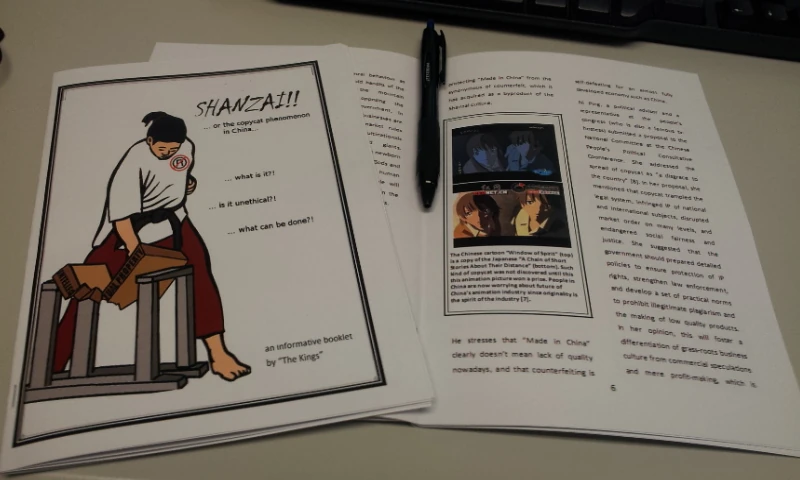
The group consisted of 8 people, with Riccardo from Italy as team leader, plus 5 mainland Chinese and 2 Hong Kong Chinese. We 7 Chinese were divided into three groups, each working on different sections. I was responsible for finding cases—shanzhai buildings (copycat White House), shanzhai animations (High-Speed Rail Man), shanzhai software (Facebook), shanzhai everyday items (KFG laundry detergent), etc. Don’t call me a traitor—these things really do exist in China. Two issues arose:
A mainland girl was supposed to handle the Introduction, but she hadn’t done anything. Instead, she copied two paragraphs from the internet and sent them to Riccardo. She probably got used to this back in China and couldn’t stop in Hong Kong. This put our Italian classmate in a difficult position. Although we all know Italy is the China of Europe—spitting in public and not queuing are common—they take work seriously. When he discovered the plagiarism, he refused to use her material. Then during workload distribution today, the team leader insisted on giving her only 5%, not a penny more. For a PolyU PhD student, failing to score 85 on a course means failing. With 5%, she’d basically fail. So she started throwing a tantrum, demanding a larger share—crying, yelling, and carrying on. But her English wasn’t as good as the Italian’s, so she couldn’t argue her case. When the leader suggested taking it to the professor, she didn’t dare—because if plagiarism was discovered, she’d likely be expelled and sent back to mainland China. After much drama, the Italian guy, who must have studied some “harmonious society” theory, agreed to give everyone 12.5% for the sake of harmony. This reminded me of how back in China, some students coast through group projects on others’ work and still get good grades. In China, where the whole society lacks integrity, it’s somewhat understandable that students aren’t saints either. But here in Hong Kong, a society built on integrity, pulling the same tricks—what’s the point of coming here? At this thought, I couldn’t stay silent. I stood up and said No—this is an Ethics course, how can we be so unfair with grades? It has to be fair! I got a dirty look from my mainland compatriot, but my insistence paid off. After another half hour of bargaining, we settled on 7% for the girl, 13% for me, and 21% for our Italian friend. Honestly, we were already being too generous. Since you voluntarily left the warm embrace of socialist motherland to study abroad, unethical behavior shouldn’t be sheltered. I hope she learned something from this. Otherwise, she’ll keep paying the price.
There was also a minor incident during the meeting. A Hong Kong student forgot about the meeting and didn’t show up. When we called, he said he’d forgotten. After hanging up, he must have realized it wasn’t a good excuse, so he texted: “I am sick, can not be there, very sorry.” He would have been better off not sending that. When we received the text, we were already arguing heatedly about honesty, and suddenly here was more dishonesty—first he said he forgot, now he’s sick. If you’re sick, why didn’t you ask for leave earlier? His share was instantly reduced by 1% with everyone’s agreement. Seems like Hong Kong compatriots share some common traits with mainlanders.
The second assignment was to write an individual paper discussing ethical issues related to our own field. I wrote about ethical issues in流氓软件 (rogue software). Everyone’s paper had to pass through an online anti-plagiarism system to check similarity. Although definitions of plagiarism vary, the system flags any sequence of 7 consecutive words that match another source, regardless of citation. By strict definition, even cited material has length limits. The system is very strict.
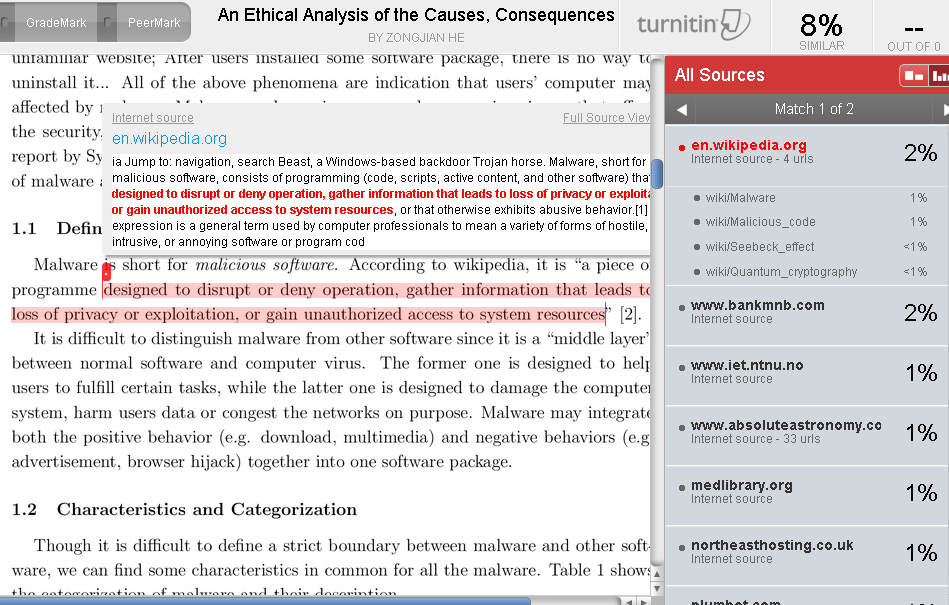
After submitting my paper, the system reported 8% similarity. That 8% was somewhat unfair—some matches were in the references section, where my paper and another paper cited the same reference. The red parts in the image (click for full size) were not unfair though. I had quoted a definition from Wikipedia—barely half a sentence—and the system caught it. Marked in red, requiring revision and resubmission.
Back in China, anti-plagiarism efforts have always been all talk and no action. They exist but aren’t used. Why? Because once such a system is implemented, it wouldn’t just expose students—it would expose a lot of vested interests. Academicians, professors—they’d all get caught. Looking back at my education from primary school through university, I don’t recall a single course that taught me what constitutes plagiarism, what’s infringement, what’s unethical. Even if such a course existed, most would dismiss it as another extension of Marxist philosophy, Deng Theory, or the “Three Represents”—just another burden. Or perhaps that’s just the broader environment.
My own papers and books have been plagiarized too. I’m no saint—I’ve also copied from the internet to get assignments done. Why write this? Consider it a note to myself: never plagiarize again. And if I dare to hope for more, perhaps those who read this might take something away from it.