Introduction to New Zealand's MMP System
Update: This was written just before the election. The election has concluded, and the King-maker scenario I feared most didn’t happen. I have more confidence in NZ’s MMP system now.
Rules
Germany truly is a nation of thinkers — many of the world’s social systems originated there. Communism/socialism originated with Germany’s Marx. New Zealand’s political system also originated in Germany. (Nazism also originated in Germany, but at least that didn’t spread worldwide.)
As President Jiang Zemin noted during his US visit: “American democracy has American characteristics, different from democracy generally speaking. Seeing is believing.” Indeed, while all democracies use voting, the implementations differ vastly. New Zealand has its own characteristic democracy: the MMP system. Having participated twice in NZ elections, I can share my observations.
The American-style democracy Jiang mentioned is a two-party system. Under that system, founding a small party leaves no chance of winning. The two major parties naturally drift toward centre-left and centre-right (Trump’s GOP tilts right, Biden’s Democrats tilt left), which is the only way to appeal to most voters.
MMP was designed to address this. MMP stands for Mixed Member Proportional. The core idea is to amplify the voice of smaller parties by encouraging cooperation — forming coalition governments. We studied Mao’s “On Coalition Government” in school, but I never saw much coalition-building in China. As a luxury villa ad said: “Exclusive, therefore noble.” Who wants to share power?
But in New Zealand, coalition governments are common. MMP requires a party (or coalition) to get over 50% of votes to form government. In NZ history, only Jacinda Ardern’s Labour in 2020 surpassed 50% alone. Every other time, multiple parties must cooperate.
That’s why NZ has so many parties. This election featured 17 parties, with party introductions spanning several pages. Some are quite quirky: the Cannabis Legalisation Party, the Animal Justice Party, the Women’s Rights Party, etc. The previous term had an Internet Party, but it’s gone this term — perhaps it lived up to its name and “disconnected.” I actually thought it was decent; the internet surely represents the future.
Despite the abundance of parties, entering parliament is tough. Parties typically need over 5% of votes to get seats. You can’t just start a party and walk in. Only once in parliament can you cooperate with others and potentially form government. In short: MMP encourages cooperation to boost smaller parties’ voices.
Of course, each voter gets two votes: one party vote (executive branch) and one electorate vote (legislative branch — like electing MPs or “people’s congress” representatives). Today we’ll only discuss the party vote. NZ’s electorate system has its own issues — maybe another time.
Problems
This multi-party cooperation sounds well-designed, but what are the issues? The biggest problem is the coalition formation process itself.
Take the 2017 election. I was in NZ but hadn’t lived here a year, so I couldn’t vote. I watched from the sidelines. The results:
| Party | Vote Share |
|---|---|
| National Party (centre-right) | 44.4% |
| Labour Party (centre-left) | 36.9% |
| New Zealand First Party (?) | 7.2% |
| Green Party (far-left) | 6.3% |
| ACT New Zealand (far-right) | 0.5% |
| …. | … |
Table: 2017 NZ Election, source: New Zealand 2017 General Election - Official Results
Left-wing parties Labour + Green = 43.2%. Right-wing National + ACT = 44.9%. Neither side cleared 50%. A coalition was needed. But left and right couldn’t coalition — too far apart politically. You can’t imagine National pulling the Greens in to reach 50%. So it was a stalemate.
All eyes turned to NZ First. Whichever side they joined would govern. They were effectively the “King maker.”
NZ First is hard to pin down. Their policies defy simple left-right classification. I won’t comment further. Suffice to say, it’s essentially leader Winston Peters’ personal party.
Why is this frustrating? The coalition negotiation process is completely opaque. Nobody knows why Winston Peters chose one side over the other, or what interests were traded. Rumors ran wild. It seems this is universal: wherever there’s opacity, rumors flourish.
In summary, my two biggest complaints about MMP: First, coalition options are very limited — usually one major plus one minor party. When left and right are evenly matched (statistically likely), one person or party becomes the King maker. Second, the negotiation process is entirely non-transparent.
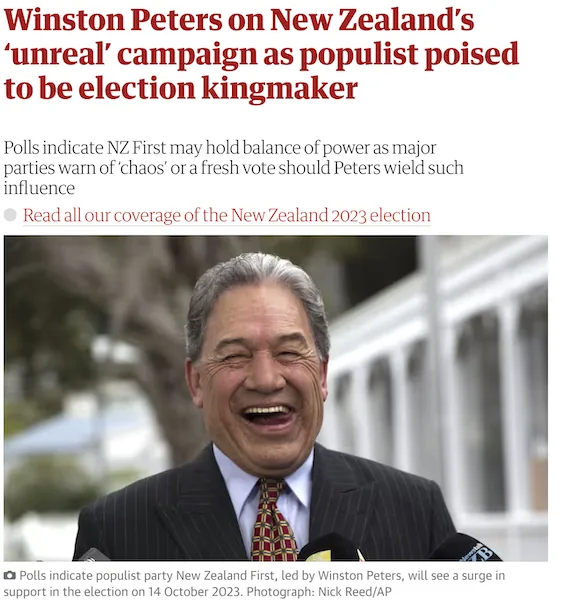
Figure: Media predictions before this year’s election suggested another King maker scenario.
Origins
They say NZ’s MMP originated in Germany. Does Germany have the same problems? Let’s look at the birth country.
Over lunch one day, I asked a German colleague: “NZ’s MMP comes from Germany. How’s it working for you? Do people support it?” He said, “Of course we support it. Our two biggest parties often form a coalition government together.”
I was stunned. What? The two largest parties, bitter rivals before the election, get together afterward? Isn’t that a betrayal of voters? Aren’t your voters angry?
He said it’s fine. Look at Merkel — she governed for years until she chose to retire.
I looked into it and found different national conditions indeed.
First, German election results differ greatly from NZ’s. Many parties gain popular support and enter parliament. Here’s Germany’s 2021 election:
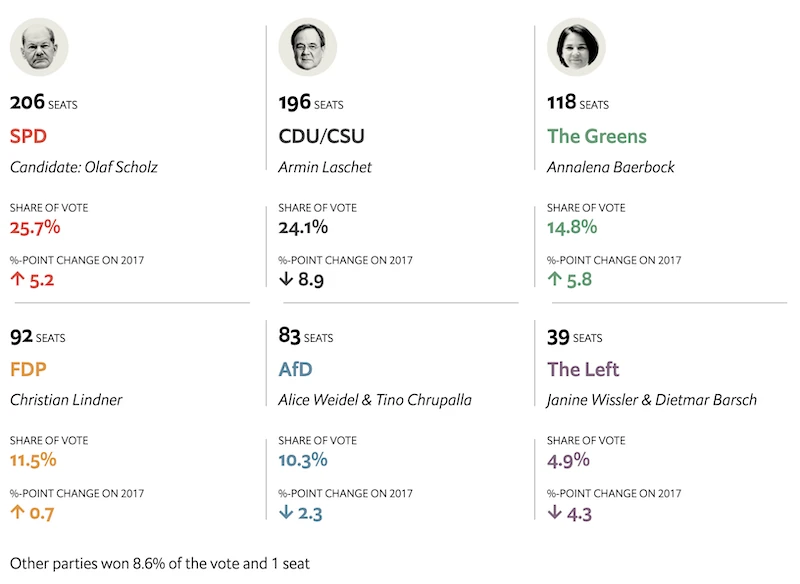
Even the two largest parties combined didn’t reach a majority. They still needed more partners. But with more parties represented, many coalition combinations were possible:
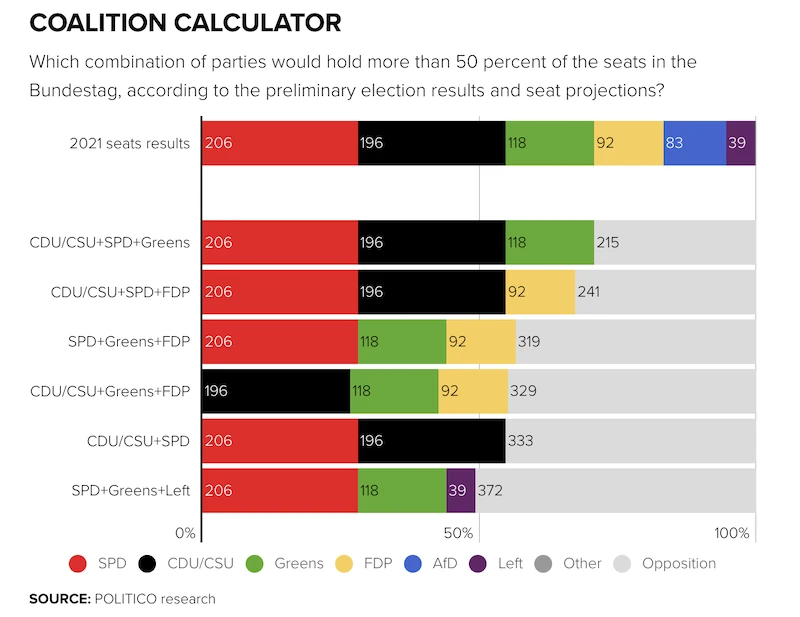
Many possibilities, many choices. That’s why Germany could even have its two largest parties coalition. Makes sense.
In NZ, usually only 4-5 parties hit the 5% threshold: one centre-left, one centre-right, one far-left, one far-right. So everything depends on NZ First.
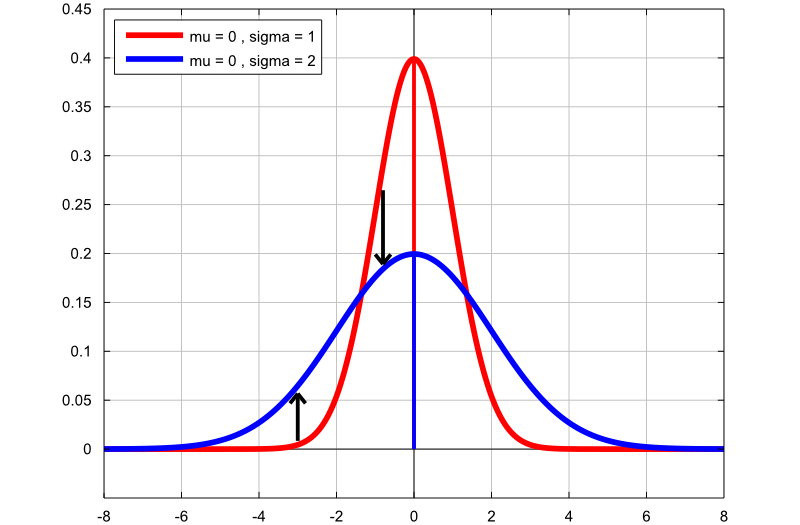
Both NZ and German voting patterns are statistically normal. A healthy society’s political views follow a normal distribution: most people are centre-left or centre-right, with a few extremes. But the normal distribution has parameters: mean and variance.
The mean represents society’s overall left-right orientation. I think NZ’s mean tilts left. Even the right is somewhat left-leaning. A standard right-winger like Trump is hard to find.
The variance represents ideological diversity. I think NZ’s variance is small — most people are fairly similar. So centre-left and centre-right parties naturally get 40% each, and occasionally (like 2020) one party surpasses 50%.
Germany’s variance is larger — people are more diverse. Votes are more spread out, so even two big parties can’t reach a majority. This guarantees coalition diversity.
Conclusion
“Different national conditions” is indeed an eternal truth.

Copying another country’s system wholesale doesn’t guarantee it’ll work for you. Every political system has its assumptions and適用範圍. If those assumptions aren’t met, the system distorts.
MMP requires diversity in both parties and voters — enough variance in the normal distribution. But NZ’s parties and voters aren’t diverse enough, so MMP sometimes distorts.
Germany, the birthplace of MMP, is itself reforming. In 2023 it upgraded to AMS. I hope NZ’s political system continues to improve and better serve the country.