iPhone vs Android vs Windows Phone (Part 2)
What a tragedy!! I’d already finished writing this part when I accidentally hit backspace and navigated to a previous page. Everything was gone—I could cry. I should have finished writing in Word first before pasting. This section is a bit brief because I don’t want to type it all again. Keeping everything minimal, so the quality will definitely suffer.
Experience:
The term “user experience” isn’t new, but smartphones have given it unprecedented attention. Even software schools now offer HCI courses. Last year at PolyU I took “Human Computer Interaction,” and the professor highly praised the iPhone, saying it conforms to several HCI principles. Of course, theory is gray—if they made everyone calculate entropy and probability in class, some would be miserable.
On user experience alone, I’d vote for iPhone. It was iPhone that showed everyone what a phone “should” be. Previously, Microsoft’s approach with Windows Mobile was to transplant PC concepts onto phones—”Phone is PC.” I was also fooled by this. Phone is PC—a phone that is a computer—amazing! But then iPhone came out, and everyone suddenly realized we’d been deceived. Phone is PC is wrong! Phone is Phone, PC is PC. You can’t force one thing onto another.
Take zooming in and out, for example. How do you do it on a desktop? A plus button and a minus button—click plus to zoom in, minus to zoom out. If you zoom in too much, use scrollbars to navigate. Windows Mobile brought this same approach to phones. iPhone is different. The most intuitive zoom operation is pinch, which follows the HCI principle of Direct Manipulation. Of course, this depends on hardware support, but Apple didn’t invent capacitive screens either—the patent dates back to 1986. It was Apple that showed everyone the benefits of capacitive screens.
Another thing is scrollbars. On phones they’re too thin, with high error rates, and should be used sparingly. Microsoft must have realized this too. By WP7, they completely removed scrollbars—going from one extreme to another. And the result? Some apps became tragic. WP7’s Adobe Reader is one example. Without scrollbars for quick sliding, no bookmarks, no quick navigation—you can only flip pages by swiping. It works for a few pages, but with many pages, it’s unbearable. I have a 900-page PDF that I read a few pages of before bed. Every time I open it, I start from page one and frantically swipe to reach where I left off. For the past few months, the first thing I do when I get into bed is swipe the screen五六百 times (five to six hundred times), eyes closed, until I get to where I was. Sometimes I’m so tired I fall asleep before reaching my page.
Speaking of reading, WP7 has another problem: screen rotation can’t be locked. So when I read lying down, I have to maintain a特定体位 (specific posture) to read. Turning over rotates the screen. For an old guy like me it’s fine, but for a kid, it would definitely affect healthy bone development. With this kind of experience, I still managed to read that 900-page PDF up to page 800. If that’s not love for Microsoft and WP7, what is?
WP7 doesn’t even have a screenshot function, so I can only share an original image from the market.
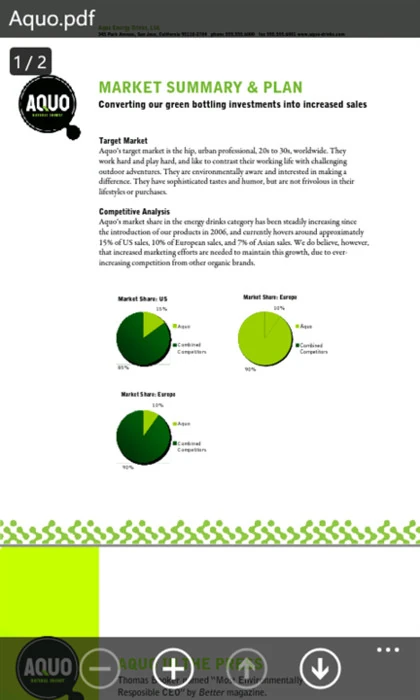
Caption: PDFs with one or two pages are okay, but beyond that, it can’t hold up.
When it comes to experience, Android and iPhone are similar. Microsoft’s Metro UI is quite unconventional. I’ve been trying to find an objective word to describe it—after much thought, “unconventional” is the best I can do. Microsoft woke up early but showed up late for the party. As a latecomer to the mobile OS scene, they had to do something different to attract attention. Metro UI is that something. Many people like it, many don’t. It’s a matter of personal taste. If iPhone and Android represent ordinary experience, then both “artsy” and “foolish” experiences can be awarded to Metro UI. Artsy because it’s unconventional, innovative, and different. It’s genuinely refreshing after using Android and iPhone. Foolish because it was rushed to market with some poorly thought-out aspects. For example, the official Sina Weibo app heavily uses panorama views嵌套 (nested within each other). Unlike traditional tabs, the panorama approach doesn’t let you see the full picture—you have to swipe left and right to see everything. With nested panoramas, you easily get lost, not knowing which layer you’re in. Pressing the back button, you don’t know how many times you need to press to return to the top level.
Of course, experience also depends on hardware. Apple excels at optimization; when optimization can’t go further, throwing more hardware at the problem is a reasonable choice. That’s why both Android and WP7 have their share of hardware spec inflation.
If I were to score experience, I’d give Apple 100 points, Android and Windows Phone 80 points each.
Predictions:
Time for predictions again—heavy pressure! Let’s set the prediction horizon at five years. What will the iPhone 9S, Android 9.0.2, and Windows Phone “Lego” look like?
I feel that software vendors are taking center stage, signaling that the smartphone industry reshuffle is largely complete. Five years from now, there shouldn’t be massive market changes.
iPhone’s market share should remain similar to now. If I must predict a trend, I’d say downward—similar to the Mac vs. PC competition back in the day. As I said earlier, strategy prevents iPhone from dominating the world. An uncertain factor is the loss of Jobs. Companies like Apple sometimes need a spiritual leader to “control” certain people. Of course, China is a different story—there it’s still about face. Many people buy iPhones just for calls and texts, without installing a single app, purely for show. Worst case, iPhone might become an “artsy” phone, like the Mac after the PC wars ended last century.
Android is supposedly already the #1 smartphone platform. If we use the PC war analogy, iPhone is the Mac, Android is Windows. If history repeats, I predict Android will sit in the top seat five years from now. Products will bloom everywhere, from几百-yuan migrant worker phones to几千-yuan so-called flagship phones (I still don’t understand what “flagship” means—is iPhone 4S Apple’s flagship?). The top seat is deserved. But Android needs to solve version compatibility issues and how to help developers profit. Why not set minimum hardware requirements for each app in the Market, preventing downloads on devices below the threshold? Just like PC software with minimum and recommended configurations—works fine, doesn’t it?
Windows Phone is the biggest unknown. I’ve never felt it has a uniquely irreproducible advantage. Microsoft is a big camel—even if it gets thinner, it won’t disappear. But Windows now supporting ARM is concerning. I worry Windows Phone might be eaten by its own brother. Is it possible that one day your phone runs the ARM version of Windows? Although it sounds far-fetched now, it’s not impossible.
Looking further ahead—even five years from now—will the concepts of Phone, Pad, and Laptop blur? If so, arguing about who’s #1 or #2 becomes meaningless. Either way, users will benefit. Looking forward to that day.